
Is it right for me
Who it is designed for, and who it is not.
Mytocel MSK® is designed for early to moderate osteoarthritis and cartilage damage, where the joint still has cartilage to work with.
Designed for
Where the joint still has cartilage to work with.
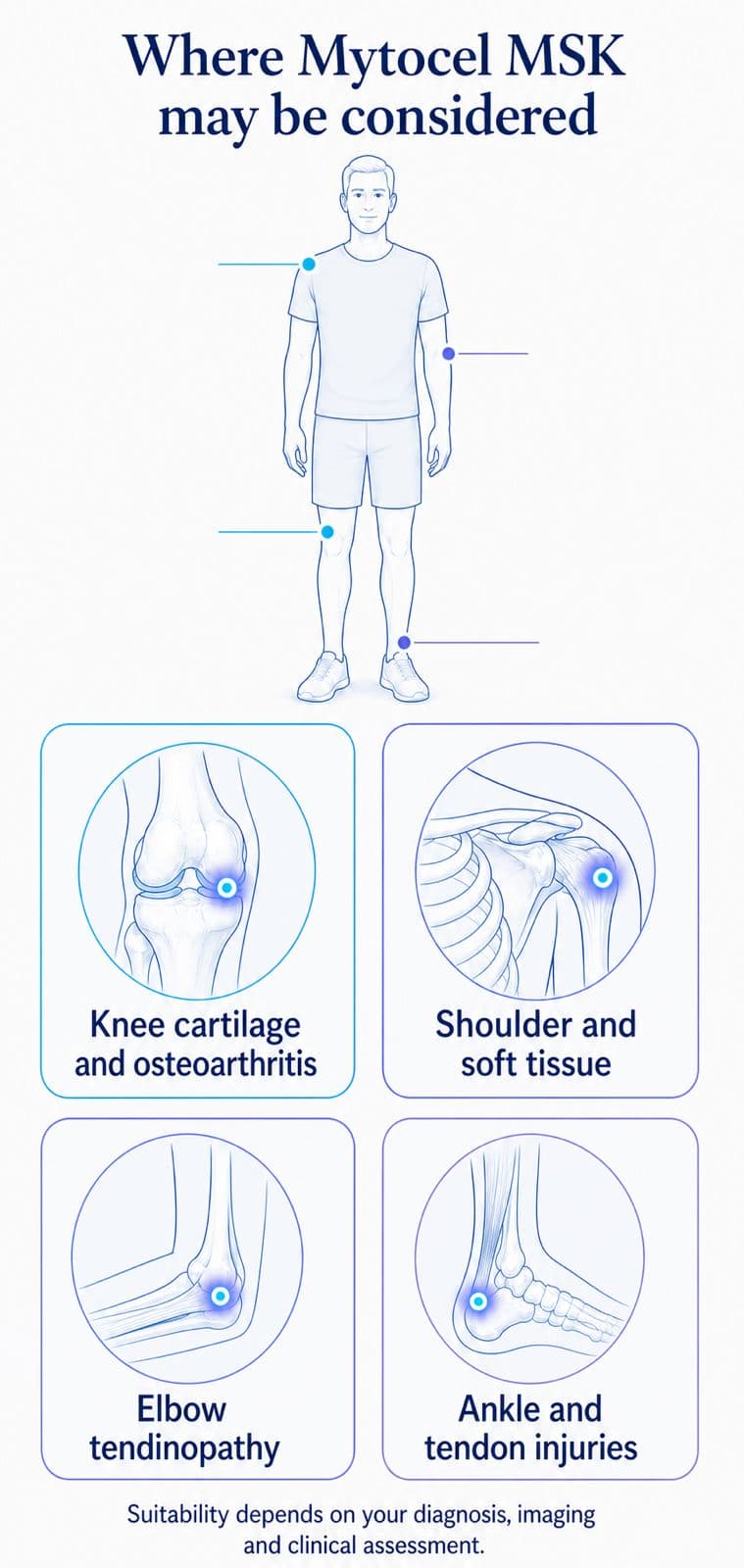
Knee osteoarthritis grade I to III
It is designed for early to moderate osteoarthritis of the knee, where the joint still has cartilage to work with. This is where the published studies were done.1
Focal cartilage injury or damage
Damage to a specific area of cartilage, where the joint still has cartilage to work with.2
Chondromalacia patellae
Softening or wear of the cartilage behind the kneecap.3
Hip, shoulder and ankle
Most of the published studies are in the knee. Clinicians also use it in other joints, such as the hip, shoulder and ankle, following the same rules about who it suits.2
Tendinopathy and soft-tissue injury
Some clinicians use it for tendon problems. There are fewer studies for this than for the knee.4
Not designed for
It is not suitable for everyone.
It is not designed for advanced, bone-on-bone arthritis.
It is not suitable for everyone. Inflammatory arthritis, uncontrolled diabetes, advanced arthritis and a recent steroid injection are among the reasons a clinician may say no.
A clinician may say no if you have:
- inflammatory arthritis
- severe obesity
- diabetes that is not well controlled
- a serious metabolic illness
- advanced bone-on-bone arthritis
- a steroid or joint injection in the last three months
Your clinician has the full list.
The decision
A clinician who has seen your scans decides.
Actomed supplies and trains clinics. It does not assess patients, and nothing on this site can tell you whether the treatment suits your joint. That answer comes from the clinician who examines you and looks at your scans.
Your clinician decides
Before you decide
Take this list with you.
You are entitled to clear answers to all of these before you agree to anything. A clinician who is confident in a recommendation will not mind being asked.
Questions worth asking at your consultation
- 1Given my imaging and my symptoms, why do you think this is a reasonable option for me?
- 2What are the alternatives, including doing nothing for now, and how do they compare?
- 3What does the evidence actually support for someone in my situation?
- 4What are the risks, the side effects and the recovery like?
- 5What would we do if it does not help?
- 6What will it cost in total, including follow-up?
Studies mentioned on this page
- 1.Marcarelli M, Zappia M, Rissolio L, et al. Cartilage micrografts as a novel non-invasive and non-arthroscopic autograft procedure for knee chondropathy: three-year follow-up. J Clin Med. 2021;10(2):322. View source
- 2.Remedi (Regenera Activa). Mytocel MSK professional protocol. Manufacturer document. View source
- 3.Remedi. Mytocel MSK healthcare professional brochure. Manufacturer document. View source
- 4.Remedi. Mytocel MSK frequently asked questions. Manufacturer document. View source
Find a clinic that offers Mytocel MSK
Actomed supplies and trains UK clinics; it does not assess or treat patients. A clinic can arrange an assessment, and being seen is not a decision to have any particular treatment.