
Indications and patient selection
Documented for early to moderate cartilage disease.
Manufacturer-documented indications for Mytocel MSK®: knee osteoarthritis grade I to III (Kellgren-Lawrence), focal cartilage injury or damage, chondromalacia patellae.
Documented indications
Where the protocol is documented, and how far it extends.
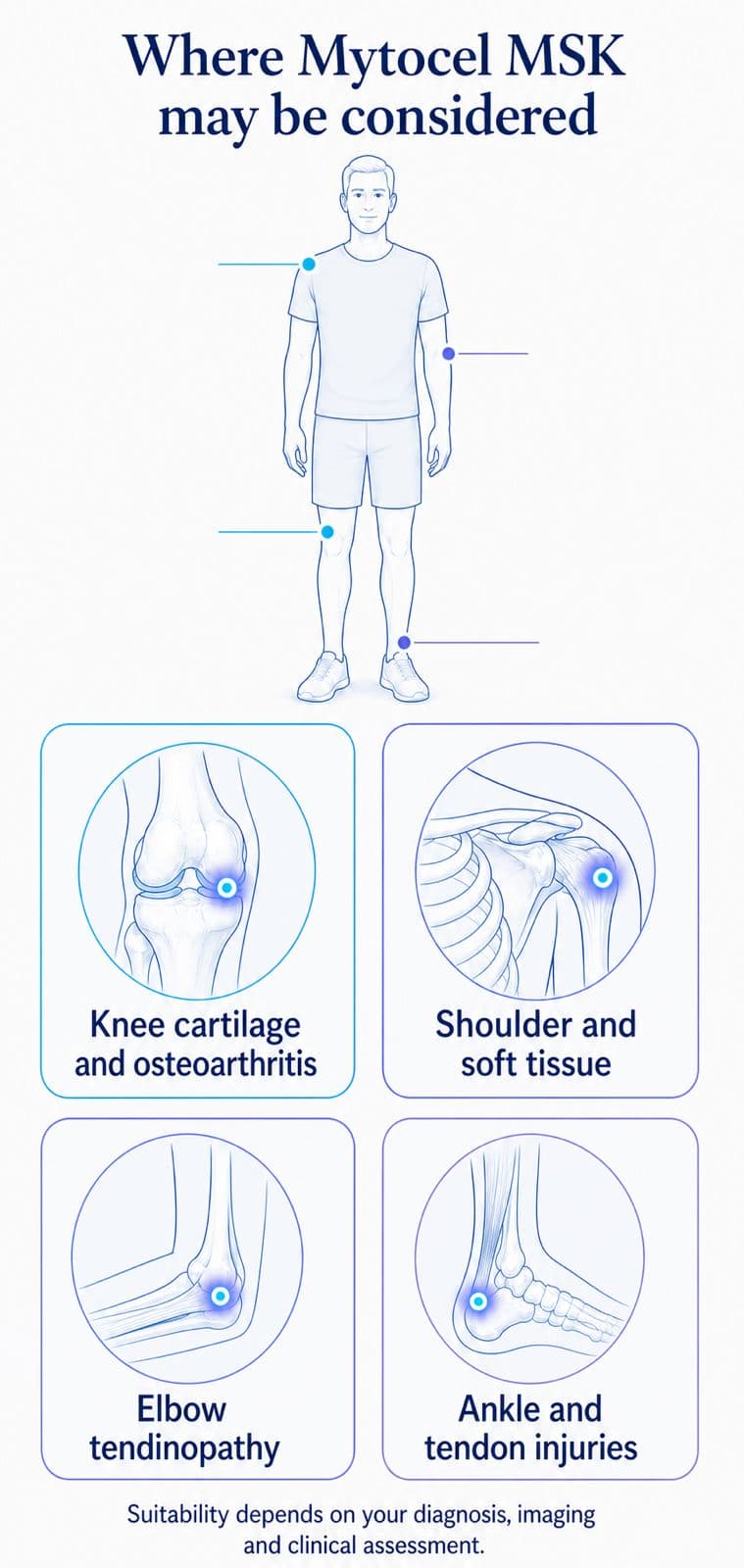
Knee osteoarthritis grade I to III
Manufacturer-documented primary indication: knee osteoarthritis grade I to III (Kellgren-Lawrence). All four published clinical series are in the knee (combined n = 37), including a three-year follow-up series (n = 8).
Peer-reviewed clinical1
Focal cartilage injury or damage
Manufacturer-documented indication: focal cartilage injury or damage, where the joint preserves at least part of the articular cartilage.
Manufacturer-documented, no published clinical series2
Chondromalacia patellae
Manufacturer-documented indication: chondromalacia patellae.
Manufacturer-documented, no published clinical series3
Hip, shoulder and ankle
The manufacturer states the protocol may be extended to the hip, shoulder and ankle using the same selection criteria; the published clinical series are in the knee.
Manufacturer-documented, no published clinical series2
Tendinopathy and soft-tissue injury
The manufacturer also describes use in tendinopathy and soft-tissue injury; no published musculoskeletal series in the supplied library addresses this.
Manufacturer-documented, no published clinical series4
Not indicated in grade IV
Exclusions
Who the protocol excludes.
The professional protocol excludes the following. Patient selection, consent and follow-up remain with the treating clinician.
- Inflammatory rheumatism (positive ANA, ASLO > 150, positive rheumatoid factor, history of inflammatory rheumatism)
- Morbid obesity
- Uncontrolled diabetes
- Severe metabolic disease
- Grade IV osteoarthritis
- Corticosteroid or intra-articular injection within the previous 3 months
Full criteria in the professional protocol and the instructions for use.
Selection
The treating clinician decides.
Patient selection, consent and follow-up remain with the treating clinician.
References
- 1.Marcarelli M, Zappia M, Rissolio L, et al. Cartilage micrografts as a novel non-invasive and non-arthroscopic autograft procedure for knee chondropathy: three-year follow-up. J Clin Med. 2021;10(2):322. View source
- 2.Remedi (Regenera Activa). Mytocel MSK professional protocol. Manufacturer document. View source
- 3.Remedi. Mytocel MSK healthcare professional brochure. Manufacturer document. View source
- 4.Remedi. Mytocel MSK frequently asked questions. Manufacturer document. View source
Bring Mytocel MSK to your clinic.
Actomed supplies Mytocel MSK in the UK with structured onboarding, first-case support and KOOS templates for structured local outcome collection.