Mytocel MSKUnited Kingdom
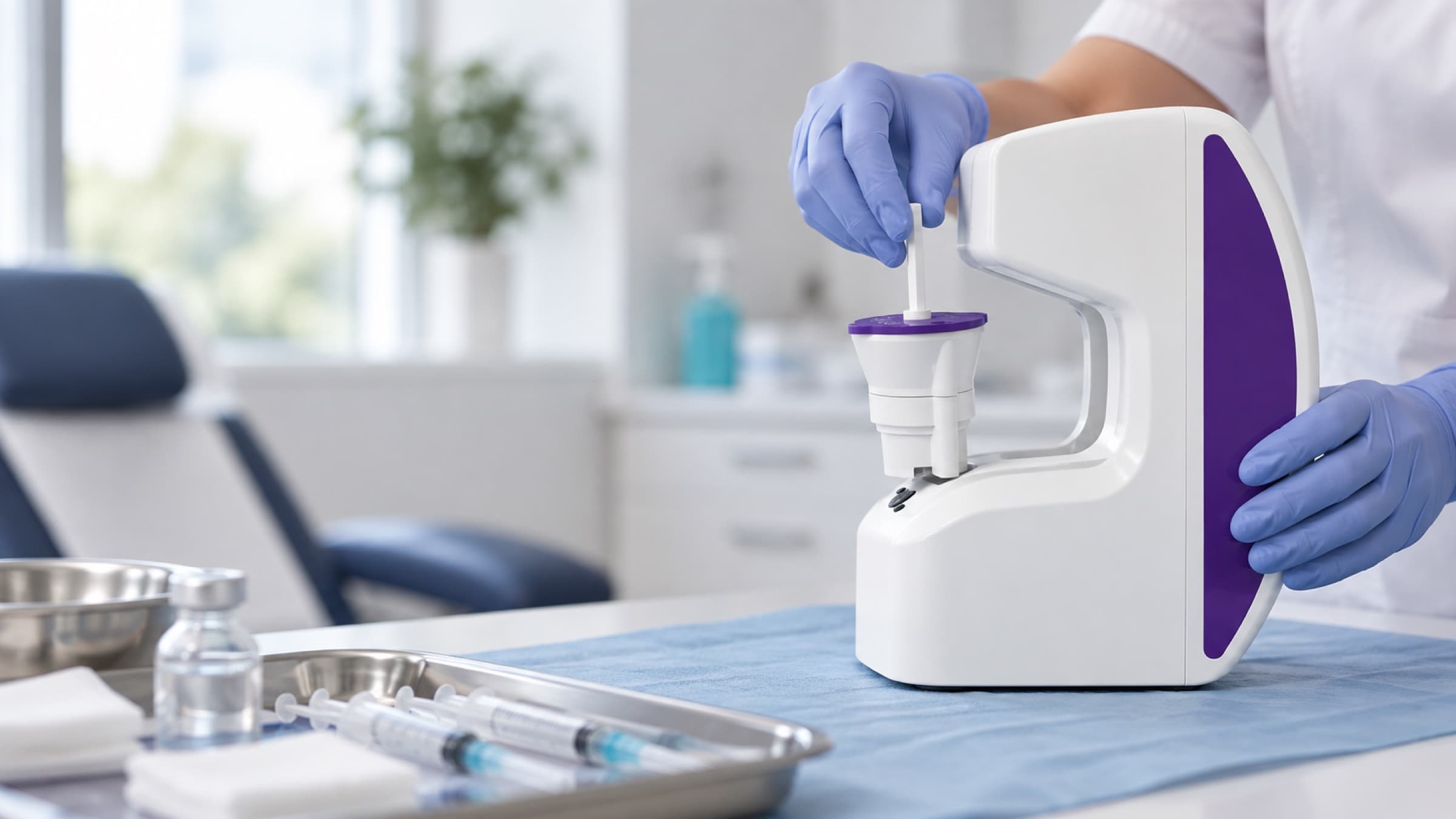
A clinician’s gloved hands placing a single-use cartridge into the processing unit on a sterile drape

Clinical evidence

The evidence, with its study design attached.

Every study behind Mytocel MSK® is listed here and linked in full. Nine publications and two preliminary reports: a three-year follow-up series (n = 8), two prospective ten-patient studies to 6 and 12 months, preliminary clinical reports, pre-clinical models and mechanistic characterisation. No randomised controlled trial has been published.

n = 81

Three-year follow-up, knee chondropathy

n = 102

Prospective open-label, KOOS at one and six months

n = 103

Twelve-month pilot, VAS, KOOS and WOMAC

Combined, the four published knee series total 37 patients. None is controlled.4

Where the evidence sits

Small prospective series with long follow-up. No randomised trial yet.

What would strengthen the evidence: a randomised comparison against hyaluronic acid or PRP, larger cohorts, standardised imaging. Actomed supports UK clinics collecting KOOS outcomes to contribute.

Evidence pyramid, top to bottom: Randomised controlled trials (none published); Prospective clinical series (n = 8 to 10); Preliminary reports; Pre-clinical models; Mechanistic characterisation. Highlighted: Prospective clinical series (n = 8 to 10).Randomised controlled trialsnone publishedProspective clinical seriesn = 8 to 10Preliminary reportsPre-clinical modelsMechanistic characterisation

Published clinical series

Three peer-reviewed series and one preliminary report, all knee, all uncontrolled.

Peer-reviewed clinical

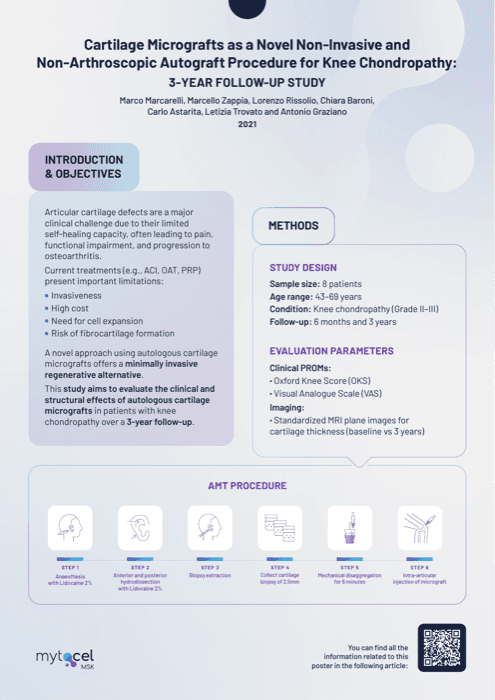
Marcarelli 2021, three-year knee series

Prospective uncontrolled case series · n = 8 · Follow-up: Six months and three years · OKS, VAS, MRI cartilage thickness

Eight patients with knee chondropathy (grade I to III). Mean Oxford Knee Score improved from 28.4 (SD 6) to 40.8 (SD 6.2); mean VAS pain from 5.5 (SD 1.6) to 1.8 (SD 0.7) at six months, with benefit reported as maintained at three years. Uncontrolled.1

Limitation: Uncontrolled series of eight patients with no comparison group; MRI cartilage thickness at three years was reported for three patients only and was mixed.

Disclosure: Three authors are employees of the technology developer.

View source
OKS in Marcarelli 2021, three-year knee series: baseline 28.4, six months 40.8, Oxford Knee Score, points, standard deviations 6 and 6.2, n = 8, uncontrolled.Oxford Knee Score, points05028.4BaselineSD 640.8Six monthsSD 6.2
n = 8, six months, uncontrolled1
VAS in Marcarelli 2021, three-year knee series: baseline 5.5, six months 1.8, VAS pain, 0 to 10 (lower is better), standard deviations 1.6 and 0.7, n = 8, uncontrolled.VAS pain, 0 to 10 (lower is better)0105.5BaselineSD 1.61.8Six monthsSD 0.7
n = 8, six months, uncontrolled1
Peer-reviewed clinical

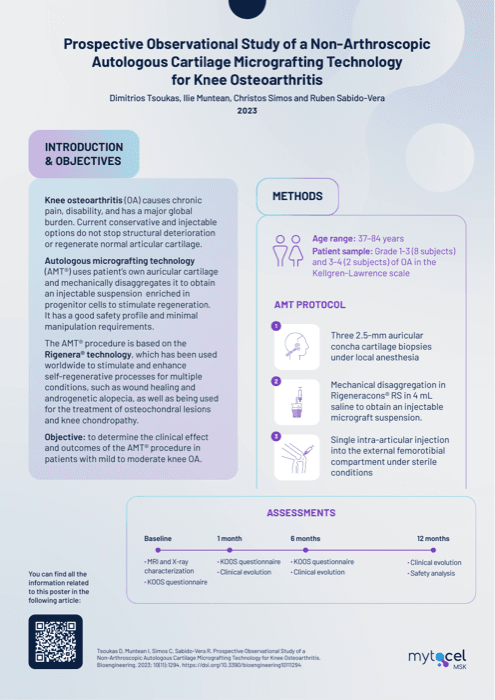
Tsoukas 2023, prospective knee osteoarthritis study

Prospective open-label observational study · n = 10 · Follow-up: Twelve months · KOOS (five subscales)

Ten patients with early-to-moderate knee OA, prospective open-label. KOOS improved at one and six months. The authors call for larger randomised evaluation.2

Limitation: Open-label with no control group; ten patients; the authors themselves call for larger randomised evaluation.

Disclosure: Medical writing funded by the manufacturer; kits supplied.

View source
Peer-reviewed clinical

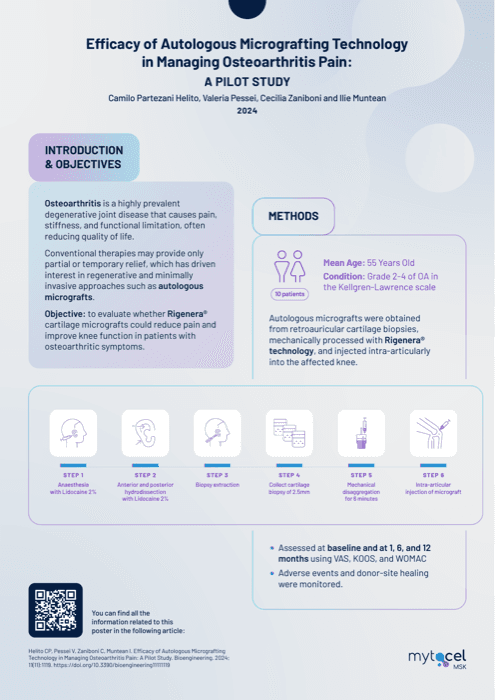
Helito 2024, twelve-month pilot study

Pilot prospective observational study · n = 10 · Follow-up: Twelve months · VAS, KOOS, WOMAC

Ten-patient pilot; KOOS, WOMAC and VAS reported over twelve months. Mean VAS pain fell from 8.3 to 2.4 at one month and was 3.3 at twelve months; mean WOMAC from 54.8 to 24.4.3

Limitation: Uncontrolled pilot of ten patients with no comparison group.

Disclosure: No external funding declared.

View source
VAS in Helito 2024, twelve-month pilot study: baseline 8.3, twelve months 3.3, VAS pain, 0 to 10 (lower is better), n = 10, uncontrolled.VAS pain, 0 to 10 (lower is better)0108.3Baseline3.3Twelve months
n = 10, twelve months, uncontrolled3
WOMAC in Helito 2024, twelve-month pilot study: baseline 54.8, twelve months 24.4, WOMAC, points (lower is better), n = 10, uncontrolled.WOMAC, points (lower is better)05554.8Baseline24.4Twelve months
n = 10, twelve months, uncontrolled3

Imaging at three years

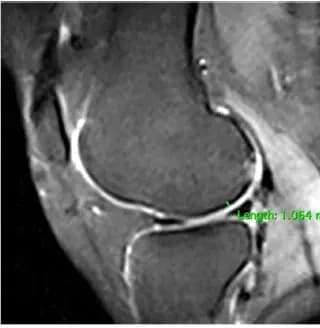
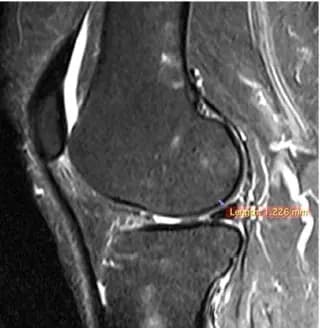
Cartilage thickness on MRI, reported for three of eight patients.

MRI thickness at three years, reported for three patients

Sagittal knee MRI plate at baseline
Sagittal, baseline
Sagittal knee MRI plate at three years
Sagittal, three years
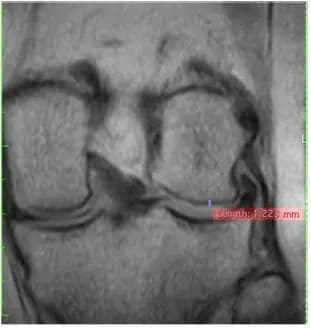
Coronal knee MRI plate at baseline
Coronal, baseline
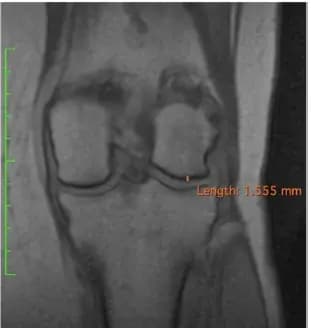
Coronal knee MRI plate at three years
Coronal, three years

MRI cartilage-thickness measurements at three years were reported for three patients and were mixed: increases in two (sagittal +15.2%, +9.3%; coronal +27.1%, +26.4%) and a decrease in one (sagittal -14.2%; coronal as printed -114%). The plates shown on this page are from one of the two patients whose measured thickness increased.1

Preliminary and pre-clinical

Rationale and early signals, labelled as such.

Preliminary

Dorta 2018, preliminary knee series

Preliminary uncontrolled series · n = 9 · Follow-up: Not stated in the abstract · WOMAC

Nine patients with knee osteochondral lesions; eight of nine improved in all WOMAC subdomains (median change 22 points). Preliminary clinical experience.4

Limitation: Preliminary uncontrolled series of nine patients; follow-up not stated in the abstract; not PubMed-indexed.

Disclosure: Published in a journal that is not indexed in PubMed; peer-review status unverified..

View source
Preliminary

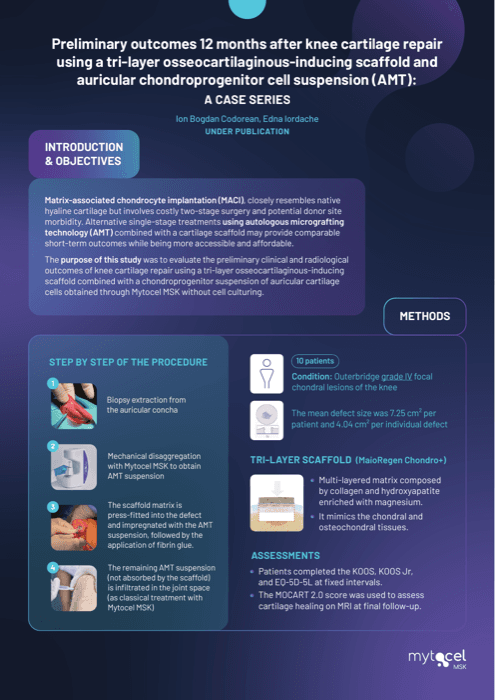
Codorean, single-stage repair with a scaffold

Single-stage repair series combining micrografts with a tri-layer scaffold · Follow-up: Twelve months

Preliminary, not yet peer-reviewed: a 12-month single-stage repair series combining micrografts with a scaffold.5

Limitation: Manufacturer-summarised only; not peer-reviewed; no publication found; the micrografts were combined with a scaffold, so this is not the injection procedure alone.

Preliminary

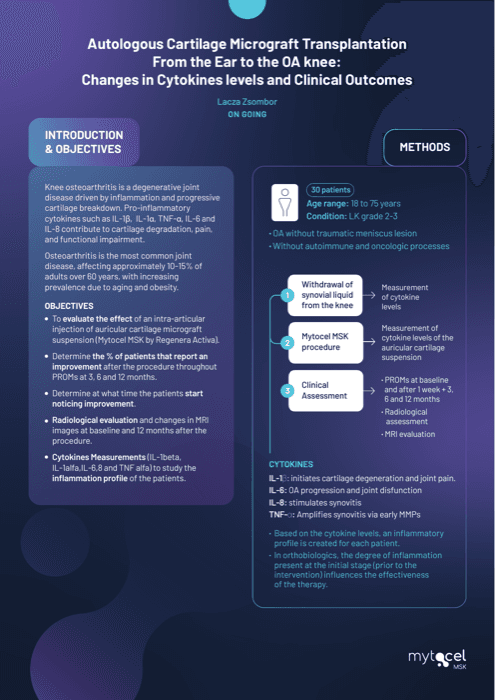
Lacza, joint inflammatory environment

Inflammatory-marker study · Follow-up: Not stated · Inflammatory markers

Preliminary, not yet peer-reviewed: an inflammatory-marker study of the joint environment after micrograft transplantation.6

Limitation: Manufacturer-summarised only; not peer-reviewed; no publication found.

Pre-clinical

Desando 2021, rat osteochondral model

Pre-clinical animal study · Follow-up: Pre-clinical, no patient follow-up · Histology

Rat osteochondral-defect model with histological assessment; pre-clinical work supporting the rationale for cartilage-derived micrografts in osteochondral repair.7

Limitation: Animal model; pre-clinical evidence only, not evidence of effect in people.

View source
Pre-clinical

Viganò 2018, characterisation and equine model

Laboratory characterisation plus a three-horse pre-clinical evaluation · Follow-up: Pre-clinical, no patient follow-up · Micrograft characterisation, Cell viability

Laboratory characterisation describing a heterogeneous suspension of cartilage-derived cells (chondrocytes and progenitor cells), pericytes and extracellular-matrix components, with viability shown, plus a three-horse pre-clinical evaluation; supports the rationale rather than human efficacy.8

Limitation: Laboratory and equine work; supports rationale rather than human efficacy claims.

View source
Mechanistic

Ceccarelli 2017, alar-nasal cartilage micrografts

In vitro and in vivo study · Follow-up: Not applicable · Micrograft preparation and characterisation

In vitro and in vivo cartilage micrograft preparation with the Rigenera protocol in an osteochondral-lesion context; not a knee outcome study.9

Limitation: Nasal cartilage in a non-knee context; not a knee osteoarthritis outcome study.

View source
Mechanistic

Astarita 2020, review of tissue micrografts

Narrative review · Follow-up: Not applicable

Review of the biological foundations of tissue micrografts and the distinction between tissue micrografts and cultured, laboratory-expanded cells.10

Limitation: Review article; no outcome data.

View source

Independent view

A 2025 systematic review of 55 micrografting studies, three of them on cartilage or bone, reported a high level of heterogeneity and risk of bias.11

Registered trials

What is in progress.

Registered trials as of September 2026; none has published results.
RegistryTitleSponsorDesignnStatus
ClinicalTrials.gov NCT0612368912Cartilage micrografts versus hyaluronic acidHuman Brain Wave S.r.l.RCT vs hyaluronic acid, KOOS at 6 months; 60 planned, 0 enrolled60Withdrawn, sponsor decision, June 2025
ClinicalTrials.gov NCT0775557913EAR2KNEERegenera Activa Worldwide with Orthosera and Semmelweis UniversitySingle arm, KOOS to 24 months, MRI at 6 months, synovial cytokines33Active, not recruiting; primary completion 21 Dec 2025; no results posted
ClinicalTrials.gov NCT0745395314Mytocel MSK versus PRPTaichung Veterans General HospitalRCT Mytocel MSK vs PRP, WOMAC at 52 weeks30Not yet recruiting; 2026 to 2030

The manufacturer-sponsored randomised trial against hyaluronic acid was withdrawn before enrolment (registry status: Withdrawn, sponsor decision, June 2025).12

Safety in the series

Autologous and minimally manipulated, so no donor material and no immunological rejection. No serious adverse events were reported in the four published knee series (combined n = 37), and donor sites healed within about a week without sutures.4123

Track record of the technology

450,000+15

procedures, manufacturer-reported, across dermatology, wound care, dentistry and orthopaedics

70+15

countries, manufacturer-reported, across dermatology, wound care, dentistry and orthopaedics

10+16

years in clinical use, manufacturer-reported, across dermatology, wound care, dentistry and orthopaedics

Manufacturer-reported: Rigenera® technology has been used in more than 450,000 procedures in over 70 countries across dermatology, wound care, dentistry and orthopaedics, and has been in clinical use for more than ten years across those fields.

Documents

Read the sources.

Professional documents

  • HCP guide

    Professional protocol

    Open PDF
  • HCP guide

    Healthcare professional brochure

    Open PDF
  • HCP guide

    Four-stage quick guide

    Open PDF
  • FAQ

    Professional frequently asked questions

    Open PDF
  • Evidence pack

    Scientific studies booklet

    Open PDF

Study summaries

  • Cover of the Codorean study summary

    Study summary

    Codorean (preliminary, not peer-reviewed)

    Open PDF
  • Cover of the Helito study summary

    Study summary

    Helito

    Open PDF
  • Cover of the Lacza study summary

    Study summary

    Lacza (preliminary, not peer-reviewed)

    Open PDF
  • Cover of the Marcarelli study summary

    Study summary

    Marcarelli

    Open PDF
  • Cover of the Tsoukas study summary

    Study summary

    Tsoukas

    Open PDF

References

  1. 1.Marcarelli M, Zappia M, Rissolio L, et al. Cartilage micrografts as a novel non-invasive and non-arthroscopic autograft procedure for knee chondropathy: three-year follow-up. J Clin Med. 2021;10(2):322. View source
  2. 2.Tsoukas D, Muntean I, Simos C, Sabido-Vera R. Prospective observational study of a non-arthroscopic autologous cartilage micrografting technology for knee osteoarthritis. Bioengineering. 2023;10(11):1294. View source
  3. 3.Helito CP, Pessei V, Zaniboni C, Muntean I, et al. Efficacy of autologous micrografting technology in managing osteoarthritis pain: a pilot study. Bioengineering. 2024;11(11):1119. View source
  4. 4.Dorta Fernández A, Baroni Luengo A, et al. Biostimulation of knee cartilage using autologous micrografts. Rehabilitation Science. 2018;3(1). Reproduced in the Mytocel MSK scientific studies booklet, p. 43. View source
  5. 5.Codorean I, et al. Single-stage knee cartilage repair using auricular chondroprogenitor micrografts with a tri-layer scaffold: 12-month outcomes. Preliminary data, manufacturer-summarised, not peer-reviewed.Preliminary, not peer-reviewed
  6. 6.Lacza Z, et al. Autologous cartilage micrograft transplantation and the joint inflammatory environment. Preliminary data, manufacturer-summarised, not peer-reviewed.Preliminary, not peer-reviewed
  7. 7.Desando G, Grigolo B, et al. Intra-articular autologous cartilage micrografts for osteochondral repair. 2021. Reproduced in the Mytocel MSK scientific studies booklet, p. 31. View source
  8. 8.Viganò M, Tessaro I, Trovato L, et al. Rationale and pre-clinical evidence for autologous cartilage micrografts in cartilage repair. 2018. View source
  9. 9.Ceccarelli G, Gentile P, Marcarelli M, et al. Alar-nasal cartilage micrografts and the Rigenera protocol. 2017. Reproduced in the Mytocel MSK scientific studies booklet, p. 19. View source
  10. 10.Astarita C, Arora CL, Trovato L. Tissue regeneration: an overview from stem cells to micrografts. J Int Med Res. 2020. View source
  11. 11.Almujaydil, et al. Systematic review of autologous micrografting (55 studies, three on cartilage or bone). J Int Med Res. 2025. View source
  12. 12.ClinicalTrials.gov NCT06123689. Randomised trial of cartilage micrografts versus hyaluronic acid, KOOS at 6 months. Sponsor: Human Brain Wave S.r.l. Withdrawn, sponsor decision, June 2025. View source
  13. 13.ClinicalTrials.gov NCT07755579 (EAR2KNEE). Single-arm study of auricular cartilage micrografts for knee osteoarthritis, KOOS to 24 months. Sponsor: Regenera Activa Worldwide with Orthosera and Semmelweis University. View source
  14. 14.ClinicalTrials.gov NCT07453953. Randomised trial of Mytocel MSK versus platelet-rich plasma for knee osteoarthritis, WOMAC at 52 weeks. Sponsor: Taichung Veterans General Hospital. View source
  15. 15.Remedi (Regenera Activa). Mytocel MSK professional protocol. Manufacturer document. View source
  16. 16.Remedi. Mytocel MSK frequently asked questions. Manufacturer document. View source

Review the evidence with your team.

Actomed supports UK clinics collecting KOOS outcomes so the published picture keeps growing.