
For patients
A treatment made from your own cartilage, in one appointment.
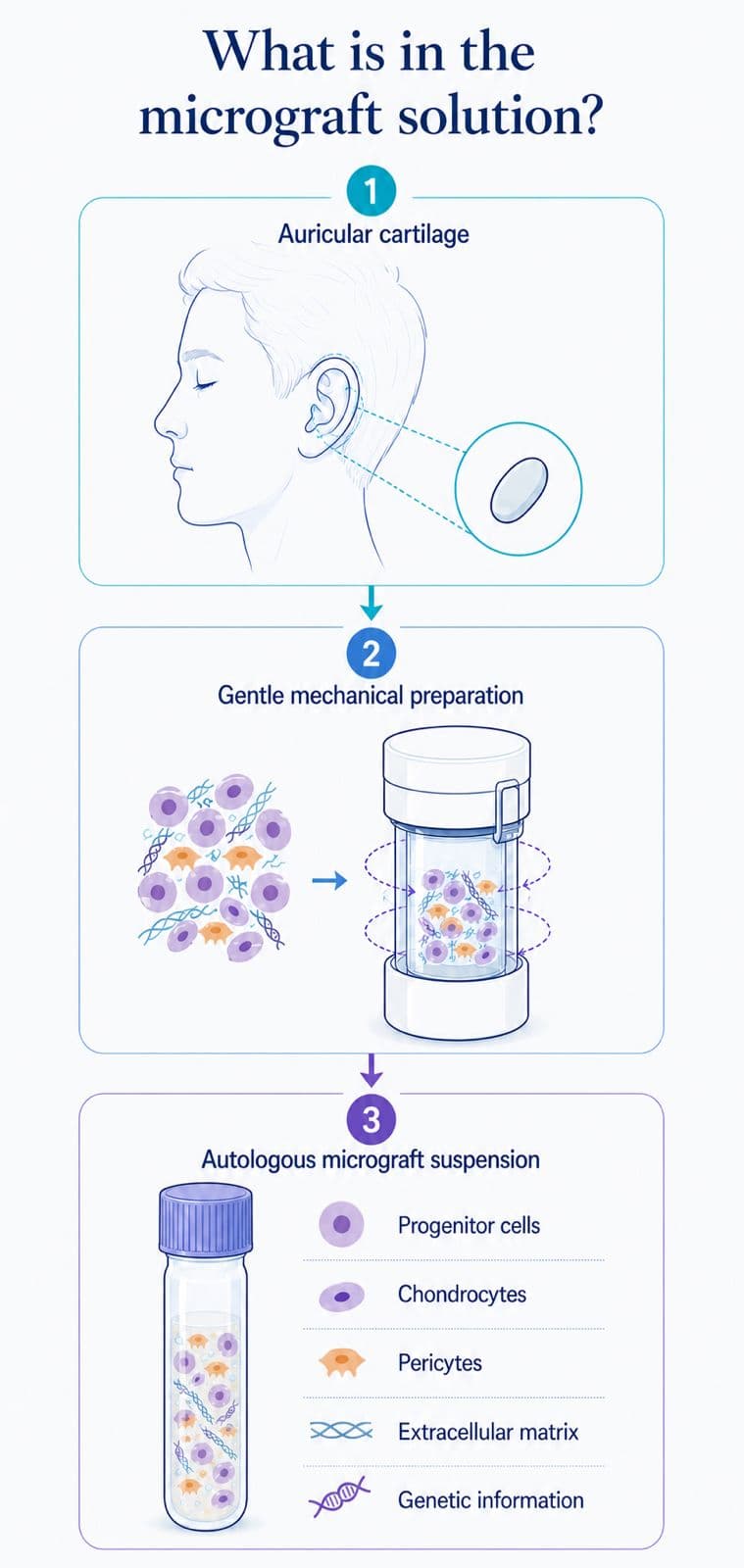
Mytocel MSK® uses a small sample of your own ear cartilage. It is prepared in the clinic, during the same appointment, into a suspension that your clinician injects into the joint.
In short
- Nothing is grown in a laboratory and nothing is sent away. The preparation is mechanical, in the room, in minutes.
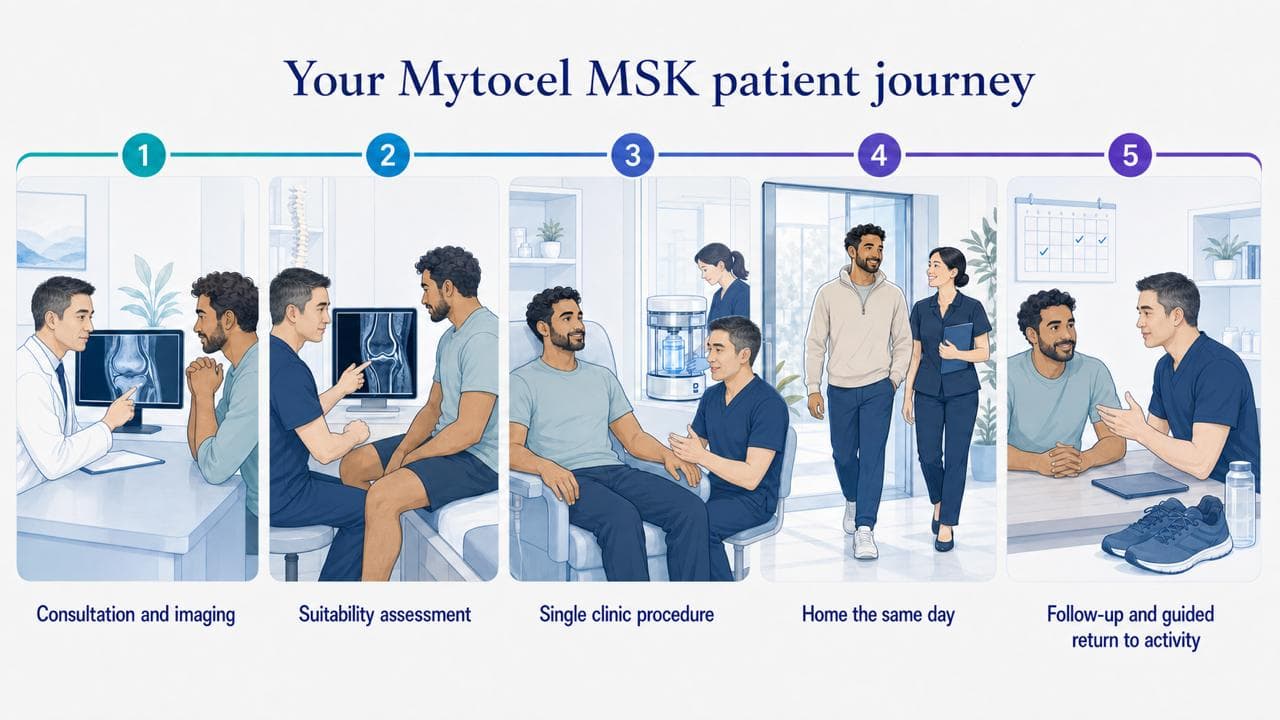
- The whole thing happens in one appointment, usually around half an hour, under local anaesthetic.
- Three tiny samples, each about the size of a seed, from behind your ear, under local anaesthetic. No stitches.
- Made in Italy by Human Brain Wave, part of the Remedi group. In the UK it is supplied to clinics, with training and support, by Actomed.
Who it may help
Designed for early to moderate arthritis and cartilage damage.
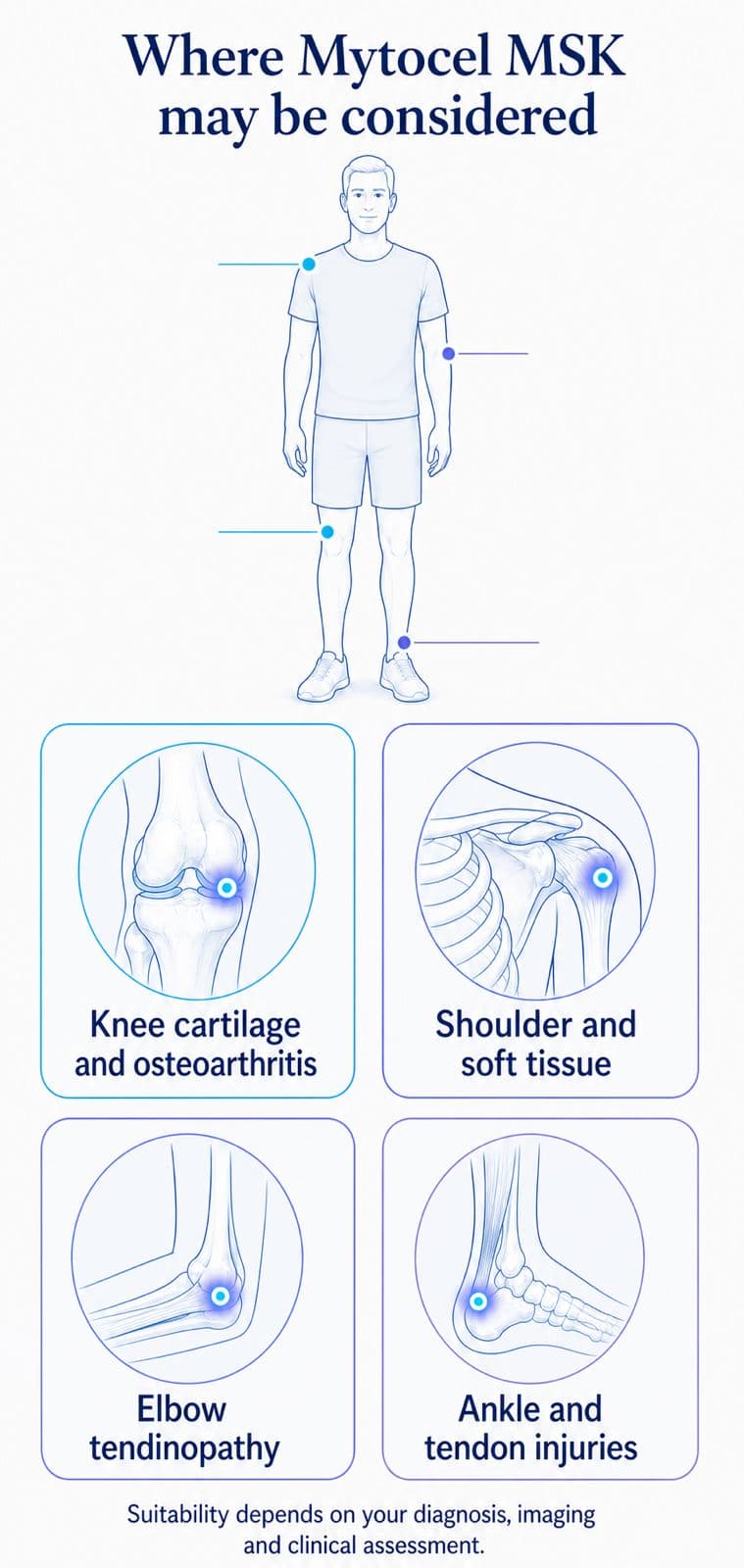
It is designed for early to moderate osteoarthritis and cartilage damage, where the joint still has cartilage to work with.
Designed for
- It is designed for early to moderate osteoarthritis of the knee, where the joint still has cartilage to work with. This is where the published studies were done.1
- Damage to a specific area of cartilage, where the joint still has cartilage to work with.
- Softening or wear of the cartilage behind the kneecap.
Not designed for
It is not designed for advanced, bone-on-bone arthritis.
What happens
From consultation to recovery.
Step 01
Prepare
The area behind your ear is cleaned and numbed with local anaesthetic. Nothing starts until a clinician has assessed your joint, your history and your scans and agreed this is a reasonable option for you.
Step 02
Sample
Three tiny samples of cartilage, each about the size of a seed, are taken from behind your ear. The tissue is your own. No stitches.
Step 03
Process
The samples are prepared mechanically in a single-use device, in the room, in minutes. Nothing is grown in a laboratory and nothing is sent away.
Step 04
Administer
Your clinician injects the prepared suspension into the joint, then talks you through aftercare and follow-up. You go home the same day.
What the studies found
Small studies, followed for up to three years.
Doctors have studied this technology in small groups of patients, followed for up to three years. The studies are small and none compared it against another treatment, so they show what happened to those patients rather than proving it works for everyone.1
Because it is your own tissue there is no donor material and no rejection. In the published studies, covering 37 people, no serious side effects were reported, though every injection carries some risk.2134
Your clinician decides
Where to start
Clinics that can arrange an assessment.
Actomed supplies and trains UK clinics; it does not assess or treat patients. These clinics can arrange an assessment. Being seen at one is not a decision to have any particular treatment.
- Visit MSK Doctors
MSK Doctors
Lincolnshire, nationwide referrals
- Visit London Cartilage Clinic
London Cartilage Clinic
Harley Street, London
- Visit Lincolnshire Knee Clinic
Lincolnshire Knee Clinic
Lincolnshire
All clinics listed share ownership with Actomed.
Studies mentioned on this page
- 1.Marcarelli M, Zappia M, Rissolio L, et al. Cartilage micrografts as a novel non-invasive and non-arthroscopic autograft procedure for knee chondropathy: three-year follow-up. J Clin Med. 2021;10(2):322. View source
- 2.Dorta Fernández A, Baroni Luengo A, et al. Biostimulation of knee cartilage using autologous micrografts. Rehabilitation Science. 2018;3(1). Reproduced in the Mytocel MSK scientific studies booklet, p. 43. View source
- 3.Tsoukas D, Muntean I, Simos C, Sabido-Vera R. Prospective observational study of a non-arthroscopic autologous cartilage micrografting technology for knee osteoarthritis. Bioengineering. 2023;10(11):1294. View source
- 4.Helito CP, Pessei V, Zaniboni C, Muntean I, et al. Efficacy of autologous micrografting technology in managing osteoarthritis pain: a pilot study. Bioengineering. 2024;11(11):1119. View source
Find a clinic that offers Mytocel MSK
Actomed supplies and trains UK clinics; it does not assess or treat patients. These clinics can arrange an assessment. Being seen at one is not a decision to have any particular treatment.